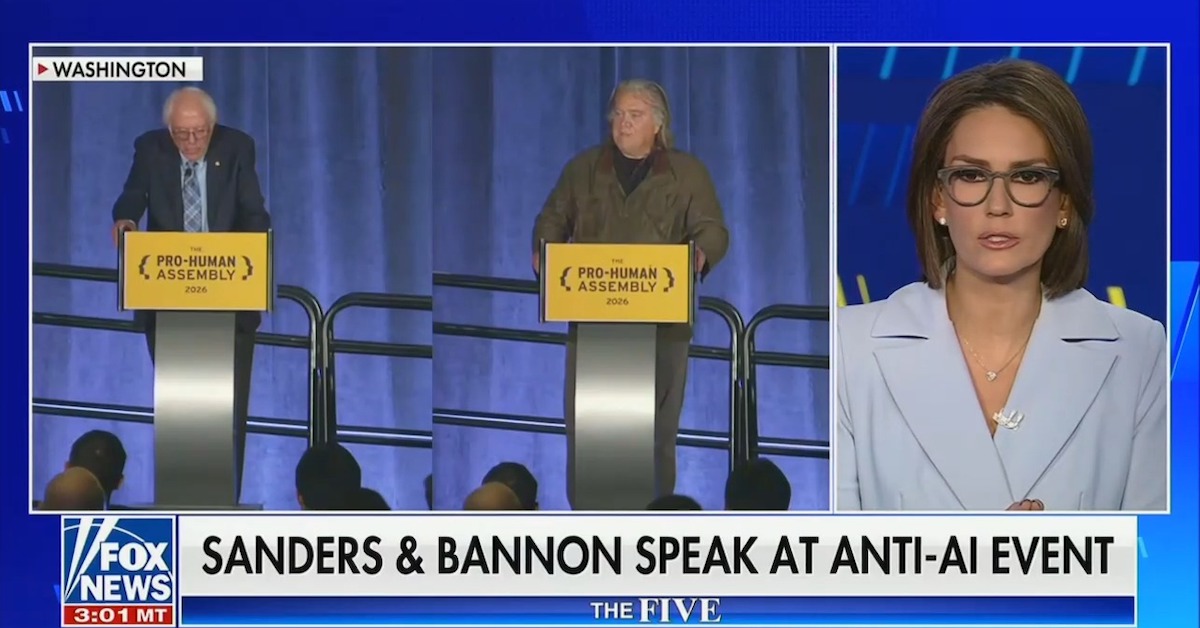
In American politics, it would be hard to find two figures more irreconcilable than Bernie Sanders and Steve Bannon — the progressive senator from Vermont, and Trump's former White House chief strategist and standard-bearer of right-wing populism. Yet on September 15, the two stood on the same stage in Washington, united in one message: pull the brakes on AI.
The event, called the "Pro-Human Assembly," was hosted by the nonprofit Future of Life Institute, advancing a "Pro-Human AI Declaration" aimed at preventing catastrophic technology risks. Sanders and Bannon spoke back-to-back, joined on stage by progressive Rep. Greg Casar, conservative Rep. Chip Roy, and religious leaders, parents and artists — a rare cross-aisle consensus on AI. Sanders opened with a stark warning about AI's "growing threat," while Casar said: "Our jobs, our freedoms and our security are at risk. It is hard to think of another issue that affects every aspect of life so fundamentally."
The political symbolism is striking. Sanders and Bannon have clashed on nearly every issue, yet came together over shared concern about AI existential risk. Analysts see a deeper trend: AI is breaking the traditional left-right divide, forming new "pro-human" versus "pro-tech" camps. Notably, the event was scheduled before former Anthropic researcher Jacob Coxon publicly warned that AI "might kill us all"; his resignation letter gave the gathering an even more immediate footnote.
Of course, the odd-couple allies don't fully agree. Sanders announced he will introduce a bill to pause advanced AI development, consistent with his government-interventionist stance on health care and education. Bannon, meanwhile, attacks AI more from an "anti-tech-monopoly" angle, targeting what he calls the "AI oligarchs." But both agree: Washington is moving too slowly.
On the same day, President Trump reiterated the opposite stance via phone to another summit — AI risk warnings are a "hoax." The multi-layered fractures between the White House and Capitol Hill, right and left, decelerationists and accelerationists, have made the AI governance fight unprecedented in complexity. When both ends of the political spectrum begin to fear the same future, the question of how to govern AI is no longer just Silicon Valley's problem.