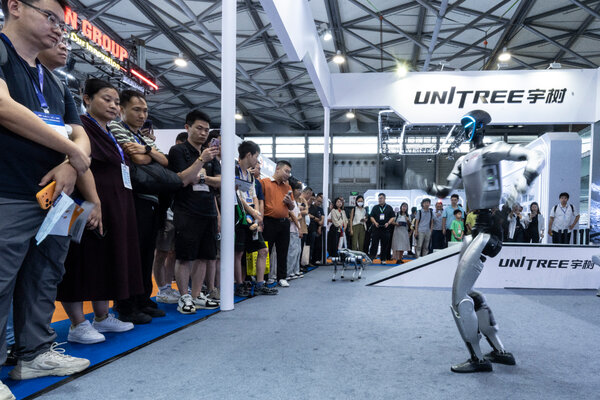
When memory chip maker CXMT and humanoid robot star Unitree completed blockbuster IPOs on the Shanghai stock exchange, they represented more than two successful listings — they signaled a strategic shift. China is accelerating its push to redirect funding for advanced technology companies from Wall Street toward its own capital markets.
According to The New York Times, government policies are encouraging promising tech companies to turn to domestic financial markets rather than relying on state subsidies or foreign capital. This marks a fundamental break from the old "start in China, get funded in Silicon Valley, list on Wall Street" model. The CXMT and Unitree IPOs embody China's twin ambitions: harnessing domestic investor enthusiasm for homegrown AI companies while reducing dependence on US technology and finance.
Tech financing is becoming geopolitical. What was once the standard path for Chinese tech companies — listing in the US — is now being redefined as a risk. This shift will reshape global capital flows. Unitree's IPO priced at 219 times earnings, far above comparable US stocks — Chinese investors value AI companies fundamentally differently from Wall Street. When China stops passively accepting Wall Street's pricing and starts independently defining the value of technology, the global valuation system becomes multipolar.
US investors will lose access to China's most dynamic tech companies as they no longer list in the US. Hong Kong and Singapore may become "middle ground" options for companies unwilling to fully commit to A-shares. Shanghai and Shenzhen are competing for the title of "preferred global tech listing destination."
For ordinary investors, the logic of "buying tech stocks" is changing. Previously, Chinese tech growth was accessible through US-listed ADRs. Increasingly, that growth will be concentrated in China's A-share market. If you have a China A-share account, that means more opportunity; if you only have a US account, you may miss out.
The CXMT and Unitree IPOs are worth watching not for how much money they raised, but for what they represent: the decoupling of technology and finance is moving from rhetoric to reality. When the world's two largest economies go their separate ways on tech financing, every global tech company will face a choice — list in the US or list in China? That choice, in itself, is changing the direction of global capital.