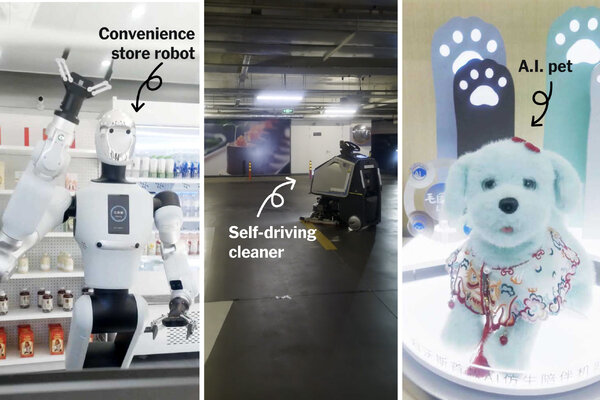
The New York Times recently published a revealing article titled "AI Is Everywhere in China: Go See for Yourself." A reporter walked through Beijing and documented how deeply AI has penetrated daily life: smart traffic lights adjust to real-time traffic, self-checkout robots handle purchases, facial recognition terminals process payments, and voice AI takes your bubble tea order with a single sentence.
Unlike Western societies where AI is often met with caution and anxiety, the Chinese public is more open and even enthusiastic about AI. This reflects two fundamentally different development paths: the US pursues peak model performance, while China prioritizes "large-scale deployment" — low cost, wide coverage, and practical accessibility above all. Rather than developing technology first and then finding applications, China starts with massive demand scenarios and lets technology iterate to meet them.
The Chinese government's "embrace plus regulate" approach actively promotes AI integration into daily life, while the US remains mired in debates about AI safety. These contrasting environments produce vastly different public attitudes. When AI becomes as ubiquitous as electricity, user expectations shift — creating even more AI application scenarios in a virtuous cycle.
International tech companies are reassessing their China market strategies: if Chinese consumers have already formed AI usage habits, overseas products entering China need to offer a complete AI experience. Chinese AI startups benefit from the large-scale deployment ecosystem, with ample user data in every niche to train and optimize their models.
If you live in China, you may take AI ubiquity for granted — but recognizing this advantage matters. Every time you use AI, you're helping improve these systems. Being an active AI user rather than a passive consumer gives you more agency in the age of AI.
China's AI success rests on two foundations: a massive user base and highly developed digital infrastructure — neither easily replicable elsewhere. But one lesson applies to all countries: when AI moves from the lab into daily life, fear naturally subsides — not because risks disappear, but because people learn to coexist with them. China is proving that the best way to popularize AI isn't through promotion — it's by making it genuinely useful.