Months before finishing her master's degree, Jin Shangyu (transliteration), an urban planning student, is watching artificial intelligence upend the industry she is trying to enter. Job boards are filling with positions requiring AI expertise, while listings for traditional roles appear to be shrinking. Much of the early-stage design work that once took a team of people can now be done with a few clicks of a mouse.
Jin, 26, from northern China, has applied to about 150 internships and entry-level positions in Hong Kong and the mainland since graduating from the University of Hong Kong — all without success. She spent $400 on an AI course hoping to stand out, but it seems to have made little difference. She figures it's no surprise: if even experienced practitioners are losing jobs to AI, what chance does a newcomer have? "My feeling is that AI is replacing exactly the segment of fresh graduates like us," she said. Asked about planning her future, she said: "I genuinely don't know where to start, because I don't see hope."
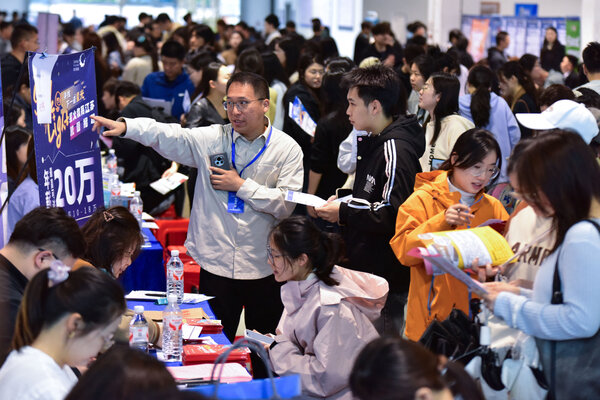
An estimated 12.7 million graduates will join China's workforce this year, the largest cohort in years of steady growth. They face two intertwined challenges. Like past graduates, they are entering a saturated job market, competing for a shrinking pool of entry-level positions amid a weak economy. But they also face a new obstacle: the extra uncertainty brought by AI, which is beginning to restructure industries and change what employers prioritize.
This is a global problem. Graduates everywhere are confronting the prospect of entry-level jobs disappearing outright. But in China, the anxiety is especially acute — the country has embraced AI at an unprecedented pace, backed by government support and broad public enthusiasm, while youth unemployment remains stubbornly high. In July, the unemployment rate for urban residents aged 16 to 24 stood at 17.9%.
High youth unemployment carries political risks for the ruling party. Scott Singer, a researcher at the Carnegie Endowment's China AI project, said any negative impact AI might have on youth unemployment, however small, is extremely sensitive for the party. Wary of the human and political consequences of the AI revolution, Beijing is pressing companies to avoid layoffs, and court rulings have signaled reluctance to accept AI-driven cost savings as grounds for dismissal.
Experts say the impact of AI and automation has so far been felt most strongly in manufacturing and food delivery, China's two largest employment categories; the effect on white-collar jobs is only beginning to show. In interviews, young job seekers described the struggle to find a foothold in an employment landscape shifting under the influence of AI — anxiety, uncertainty, and despair as applications drag on. Zhou Jinniya (transliteration), a broadcast journalism master's graduate who submitted more than 2,800 applications over the past year, said: "My spirit has been worn down."
Their only comfort: everyone seems to be struggling together. But for Jin and her peers, the deeper question is — when tools are faster and cheaper than newcomers, how do young people prove their worth? This isn't just China's problem; the world is facing it together. The answer may lie in the plain judgment that "AI replaces jobs, but not a person's ability to learn new skills" — even though, for those living through it, the pain of transition is real and slow.