Breaking News: New Record at 8.86 Seconds
On August 25, 2026, at the Global Robotic Athletic Festival held in Beijing, an artificial bipedal machine achieved an astonishing 100-meter dash time of 8.86 seconds during Tuesday's event. This stunning performance surpassed both its mechanical rivals and the fastest known human sprinter.
The competition occurred within the framework of the second annual global robotic athletic festival in China's capital. This gathering highlights the nation's swift technological progress while competing against the United States. Just three days prior, another machine had established a prior benchmark of 9.39 seconds. For perspective, the human male record stands at 9.58 seconds, set by Usain Bolt in 2009.
Expert Perspectives: Milestones and Challenges Coexist
Industry specialists are astonished by these rapid developments. Dennis Hong, an engineering professor at UCLA, described the achievement as "a significant milestone" that goes beyond merely outpacing people. He emphasized the immense difficulty of engineering a two-legged machine to operate at such velocities. He further explained that "As speed increases, balance, control, impacts" and overall structural integrity become vastly more difficult to manage.
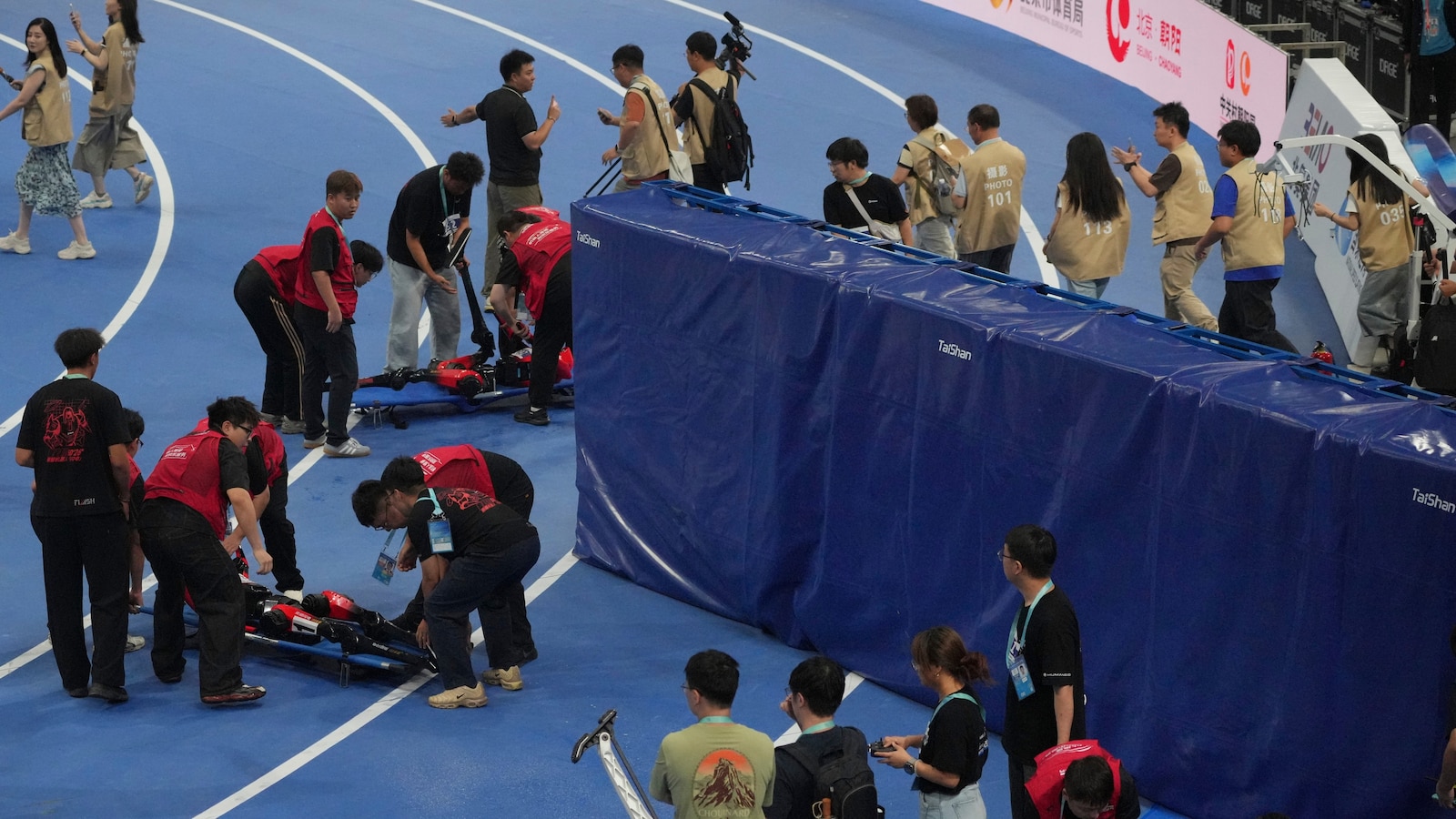
Following the race, the victorious machine crashed into a cushioned wall at the end of the track, emitting sparks from its midsection. Hong noted that this incident raises crucial inquiries regarding safe navigation, obstacle avoidance, and error recovery, which are essential for practical utility.
Event Overview: Practical Simulations Beyond Competition
The festival includes more than 1,300 contests featuring over 2,000 machines across 51 diverse activities, ranging from track and field to dancing. Unlike standard human athletic events, these mechanical participants also collaborate in practical simulations, such as domestic chores and disaster relief.
According to a state-run publication, domestic and nursing machines remain in testing stages, though "challenges are precisely where the focus" of current engineering efforts lies, as the nation's mechanical sector continues to advance toward superior innovation.
PLUS Tutorial: How to Evaluate and Choose Humanoid Robot Products
For enterprises or individuals considering introducing humanoid robots, here's a four-step evaluation method:
Step 1: Identify Application Scenarios
First determine what type of robot you need: - Industrial use:搬运, assembly, quality inspection - Service use: Reception, guided tours, cleaning - Home use: Companionship, caregiving, household chores - Specialized use: Search and rescue, exploration, hazardous environment operations
Different scenarios have varying requirements for speed, precision, battery life, and safety.
Step 2: Assess Technical Specifications
Focus on these key parameters: - Mobility: Walking speed, stability, obstacle-crossing ability - Sensing systems: Camera resolution, LiDAR accuracy, number of tactile sensors - Computing power: Processor performance, memory size, edge computing support - Battery life: Working hours per charge, charging method (wired/wireless) - Payload capacity: Maximum carrying weight, gripping strength
Step 3: Examine Ecosystem
Confirm whether suppliers provide: - Development tools: SDK, API documentation, sample code - Community support: Forum activity, number of third-party plugins - Training resources: Online courses, technical documentation, case studies - After-sales service: Repair response time, spare parts supply, software update frequency
Step 4: Conduct Field Testing
Don't just watch demo videos; request: 1. Hands-on operation: Personally operate the robot to complete typical tasks 2. Stress testing: Test stability and fault tolerance in complex environments 3. Long-term observation: Trial for at least one week, recording failure rates and maintenance needs 4. User feedback: Involve end-users in evaluation to gather real opinions
Pro Tip: Consider Total Cost of Ownership (TCO), including not just purchase price but also maintenance costs, training expenses, and potential downtime losses. Sometimes slightly more expensive but more reliable products are actually more cost-effective.
Perspective: Speed Is Not the Only Metric
The 8.86-second 100m performance is indeed impressive, but it also exposes several key issues in humanoid robot development:
-
Safety First: The post-finish collision indicates that safe navigation at high speeds still needs improvement. In practical applications, safety is more important than speed.
-
Practicality-Oriented: Competitions are just showcase platforms; true value lies in solving actual problems. Requirements for robots in household, caregiving, and disaster relief scenarios go far beyond running fast.
-
Cost Control: Currently, high-end humanoid robots are expensive, limiting large-scale adoption. How to reduce costs while maintaining performance is key to commercialization.
-
Standardization Gap: Different manufacturers' robots use different interfaces and protocols, leading to poor interoperability. The industry needs to establish unified standards.
-
Ethical Considerations: When robots can surpass human athletes, we need to rethink the boundaries of human-machine relationships. Should robots assist humans or replace them?
For investors and enterprises, now is a good time to pay attention to the humanoid robot field, but理性看待 the gap between hype and reality. Technology is progressing rapidly, but there's still a long way to go before large-scale commercialization.
In the next five years, we may see humanoid robots率先 landing in specific vertical domains (such as manufacturing, logistics, elderly care). For ordinary consumers, it may take longer to see reasonably priced, fully functional home robots.
Regardless, the 8.86-second record marks an important node in humanoid robot technology. It proves the feasibility of high-speed bipedal motion and lays the foundation for subsequent improvements in safety and practicality.