Image source: Anthropic (via The Rundown)
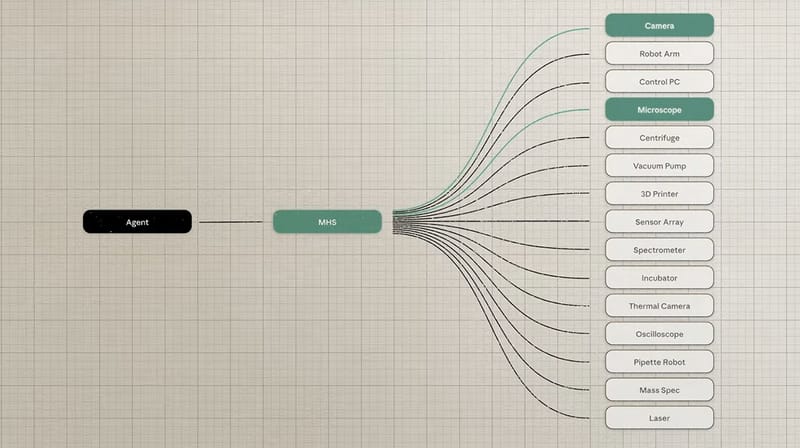
On August 28, 2026, Anthropic released Model Hardware Standard (MHS) in research preview, allowing AI agents to look up, learn, and operate real physical equipment - from microscopes and robotic arms to lab instruments. Previously, wiring AI into a device took weeks of custom code; now, according to Anthropic, it takes "hours or minutes."
The mechanism is intuitive: equipment owners describe their hardware in natural language, and MHS converts it into a reference file agents can read. In one test, Claude taught itself to align a laser through trial and error, then compressed the routine into a script that automated the job in a single pass.
MHS is best summarized as "Claude, for machines!" If MCP (Model Context Protocol) standardized how AI connects to software, MHS does the same for physical hardware - a key move in Anthropic's physical-AI race.
For labs and factories, this means: - Setup costs collapse: no more custom code per device - Old equipment gets a new life: existing instruments join AI workflows via a simple description file - Automation becomes accessible: device automation once reserved for big enterprises is now within reach
Anthropic plans an open-source release, with partners including lab giants Tecan, QIAGEN, and AWS; Hugging Face and Raspberry Pi are adding MHS to their device lines. Meanwhile: - Nvidia is reportedly acquiring Hugging Face for $12.9B - Salesforce x Anthropic: "Claudeforce" adds a 37-skill sales plugin, and Claude becomes Slack's default model - Google shipped Gemini Omni 1.1 Flash with 40-second scene extensions and 4K upscaling
For everyday users, this shift is already arriving: AI is no longer confined to chat boxes. Apple's iOS 27 includes an AI dictation keyboard and a rebuilt Siri, making "voice-command AI" mainstream. Many SF founders now work like this: whisper a 60-second brief on a walk, let an AI agent organize it into notes overnight.
- Try a "voice-directs-AI" workflow - Install an AI dictation app (e.g., Wispr Flow), dictate ideas to an agent, and have it turn them into structured notes. Speaking (~150 wpm) beats typing (~60 wpm) for richer prompts
- Add decision skills to Claude Code - Run
/plugin marketplace add coreyhaines31/makerskills; use/unstuckfor recurring blocks and/decidefor real choices - Watch for the MHS open-source release - If you work with lab, factory, or any physical equipment, try it as soon as it ships - it could become the next widely adopted standard