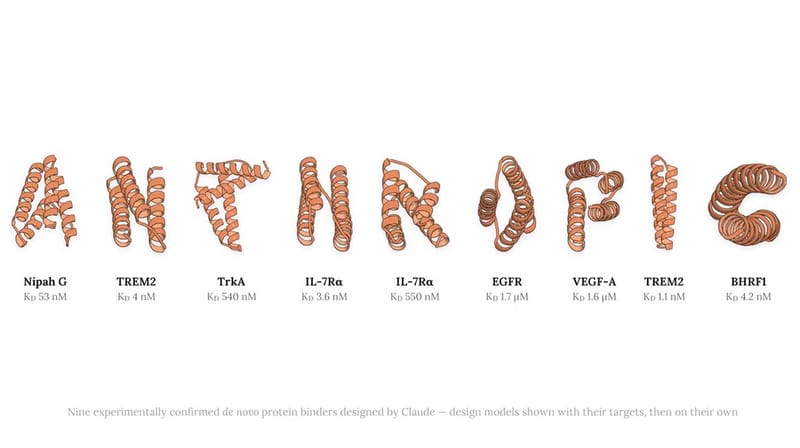
Anthropic announced that its AI assistant Claude has gained protein design capabilities, able to autonomously generate 3D protein structures with specific functions. In lab validations, Claude-designed proteins achieved a 22-35% success rate, far exceeding the industry average of 10-15%.
This breakthrough means AI is no longer limited to generating text, code, and images—it has entered the realm of "creating life molecules." Proteins are the basic building blocks of life, and designing novel proteins can be applied to drug discovery, enzyme engineering, materials science, and more.
- From digital to biological world: Previously AI dealt with bits; now it can influence atomic-level material structures
- Accelerate drug discovery: Traditional protein design takes months of experiments; AI can generate candidate molecules within hours
-
Reduce R&D costs: A 22-35% success rate means less trial-and-error, significantly cutting experimental expenses for pharmaceutical companies
-
DeepMind AlphaFold: Google's protein structure prediction tool is already the industry standard; Claude's design capability is its natural extension
- Pharma giants: Pfizer, Merck, and others have started partnering with AI companies; internal R&D teams may shrink in the future
- Regulators: The FDA needs to establish new approval processes to evaluate the safety of "AI-designed protein drugs"
You won't directly use Claude's protein design function in the short term, but the long-term impact is profound:
- New drugs reach market faster: Targeted drug development for cancer, Alzheimer's, and other diseases could shorten from 10 years to 3-5 years
- Personalized medicine becomes possible: Customizing exclusive protein drugs based on your genetic sequence is no longer science fiction
-
Biosecurity risks: Malicious actors could design harmful proteins, requiring stronger regulation and access control
-
Study basic biology: Khan Academy's "Biology" course covers fundamental knowledge of protein structure and function
- Try open-source tools: Rosetta Commons (developed by the University of Washington) is a free protein design software suite
- Follow industry updates: Nature Biotechnology regularly publishes the latest research on AI protein design