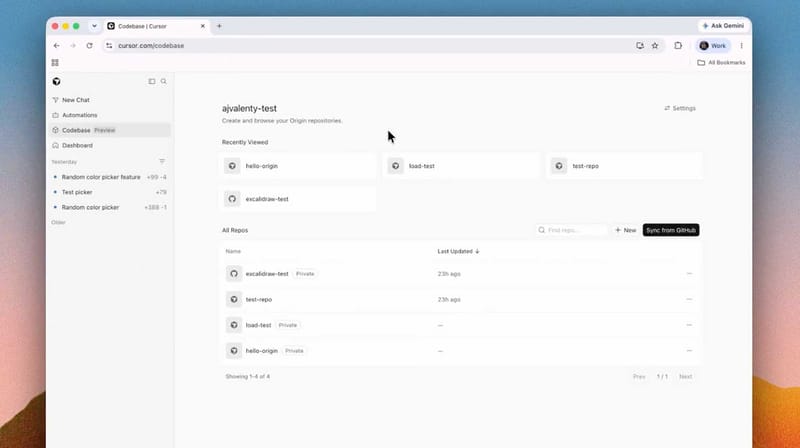
Breaking News: Origin Enters the Arena
On August 18, 2026, the AI programming landscape witnessed a pivotal shift. Just as GitHub suffered a severe service disruption, Cursor officially launched Origin, its new code hosting platform. This timing was no accident—Origin chose to enter the market when its competitor was most vulnerable, directly addressing pain points faced by millions of developers worldwide.
Origin's standout feature is its deep integration of AI Agents into the code review process. Traditional code reviews require manual line-by-line inspection, which is time-consuming and labor-intensive. Origin's AI can understand code logic, identify potential bugs, and even suggest optimizations. Crucially, it supports mirroring existing repositories, allowing developers to experience new features without migrating their codebases.
Industry Developments: Copyright and Compute Power
Two other major stories deserve attention:
ByteDance Signs Copyright Agreement with Hollywood. After multiple legal disputes sparked by generative AI (including viral celebrity clip compilations), ByteDance finalized a copyright protection framework with Hollywood executives. The agreement clearly restricts AI-generated film and TV content, setting a compliance benchmark for the industry.
Ohio Supercomputing Center Plan. Several tech giants announced plans to build a massive computing facility in Ohio, leveraging a decommissioned uranium plant site to provide gigawatt-level power. Behind this project are tens of thousands of GPU clusters and enormous credit commitments, signaling that the AI infrastructure race has entered a new phase.
Capital markets are equally hot: AI model marketplaces are being acquired at sky-high valuations, while voice and video generation startups complete large funding rounds. The entire industry is shifting from "who can do it" to "who does it faster and better."
PLUS Tutorial: Making ChatGPT Mimic Your Writing Style
Many creators want AI to maintain their personal voice rather than outputting generic machine-speak. Here's a four-step practical method:
Step 1: Activate Humanization Features
Navigate to your plugin settings and enable the "Humanize Writing" option. Test it with a rough draft and observe whether the AI reduces stiff transitions and repetitive sentence structures.
Step 2: Provide Writing Samples
Give the model a piece of your past writing as reference—such as a historical memo, blog post, or email. Your prompt could read: "Please analyze the language style, sentence structure, and word choice patterns in the following text, then mimic this style in subsequent responses."
Step 3: Install Global Skill Packages (Advanced)
If you're comfortable with the command line, you can install a global humanization skill package via terminal:
npx -y @your-skill-package/humanize-writing
Once installed, all conversations will automatically apply the style configuration without requiring manual specification each time.
Step 4: Use Professional Style Guides
Try incorporating technical writing frameworks like ASD-STE100 (Simplified Technical English Standard). Such guides force the AI to use short sentences, active voice, and limited vocabulary, significantly improving readability and directness.
By following these four steps, you can make AI output closer to your personal style, reducing post-editing workload. This is especially valuable for bloggers, marketers, and technical documentation engineers who need to produce content at scale.
Perspective: The Next Stop for AI Programming Tools
Origin's emergence marks the transition of AI programming tools from "coding assistance" to "full-process hosting." Early Copilot could only complete code snippets; today's AI can understand project architecture, participate in code reviews, and even autonomously fix bugs.
But this raises new questions: When AI deeply intervenes in the code lifecycle, how do developers ensure control? Who owns the code? How is security auditing conducted? There are no standard answers, but every team needs to think ahead.
For ordinary developers, embracing change is wiser than resisting it. Learning how to integrate AI into workflows, how to verify AI output correctness, and how to balance efficiency with security—these are the core competencies for the next three years.