Image source: University of Queensland (via The Rundown)
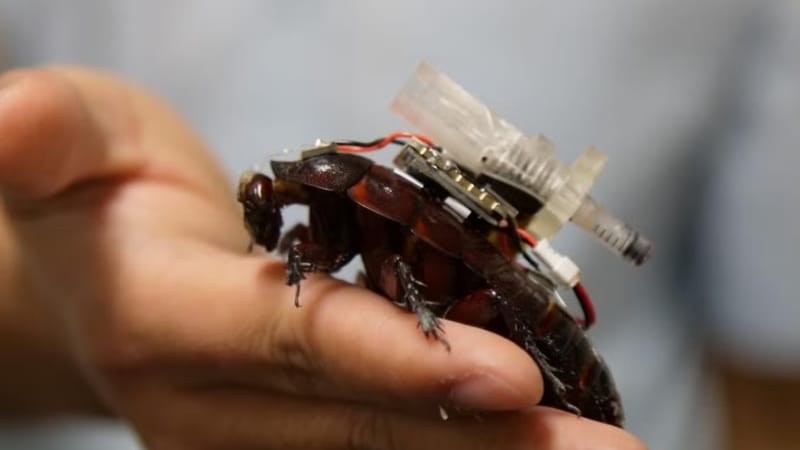
Engineers at the University of Queensland have turned giant burrowing cockroaches into "paraborgs" - cyborg insects fitted with tiny cameras and remote-triggered drug injectors, designed to find and treat people trapped in disaster zones like collapsed buildings.
The setup is straightforward: one roach carries a camera for reconnaissance, another carries the injector needle, and a human operator triggers the injection remotely. In tests, injections succeeded 95% of the time when the roach was within 15 cm of the target; the full navigate-position-inject sequence worked in 72% of trials. Engineer Thang Vo-Doan predicts rescue swarms are 5-10 years away.
On the ethics side: the roaches are anesthetized during electrode fitting and can live normal lifespans after the harness is removed.
Cyborg insects have served as search-and-explore hardware for two decades, but they were typically only designed to locate survivors and radio back positions. The leap here is intervention before humans can arrive - administering antibiotics or painkillers to trapped victims to buy critical time.
The 72% full-sequence success rate shows clear room for improvement, but the direction is set: bio-machine hybrids are becoming the "first responders" of disaster rescue.
The insect story is one corner of a much bigger robotics wave. In the same week: - SoftBank is reportedly in talks to take a majority stake in humanoid maker 1X Technologies at about $6B. The NEO robot costs $20K and took 10K preorders in five days - yet zero consumer units have shipped - Amazon plans "Project Tetromino" to fully automate delivery stations, with internal projections of 2.5x faster package processing - Generalist AI (founded by DeepMind and Boston Dynamics veterans) hit a $3B valuation just two months after its $2B mark
Robotics is in a "story ahead of reality" phase: 1X is valued at $6B with zero deliveries, and Unitree shares have fallen ~45% from their post-IPO peak. For investors, separating tech demos from mass production matters more than chasing hype. For the public, bio-hybrid robots are far from daily life, but they signal a trend: the first responders of the future may not all be human.
If you want to track this space, here are three angles to watch:
- Track "delivery metrics," not valuations - For any robotics company, check three numbers: units delivered, real customer repurchase rates, and factory capacity utilization. 1X's 10K preorders vs. zero shipments is the perfect case study
- Understand the "bio-plus-machine" route - Cyborg insects are a bio-hybrid path that complements pure humanoid robotics. Follow academic teams like UQ - they often define the technical ceiling before commercial launches do
- Build a 5-minute tech news habit - Subscribe via the sidebar on CatBlog or use RSS for robotics/AI channels; a short daily digest beats scattered scrolling