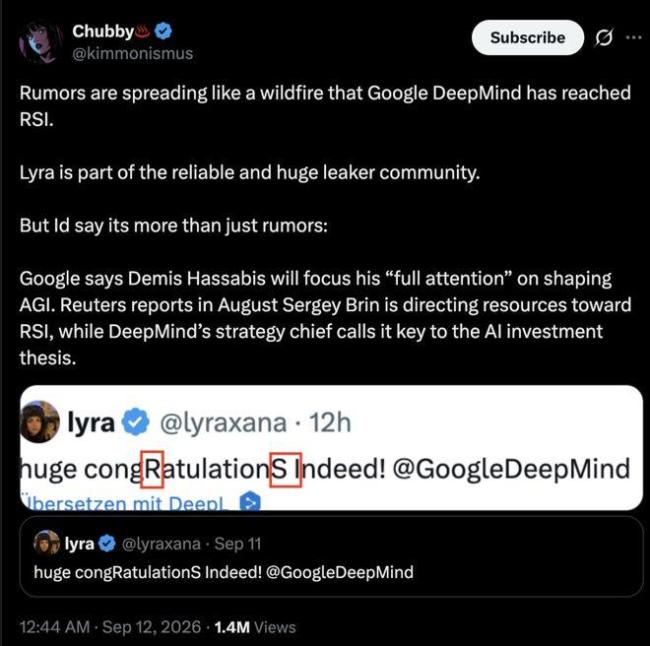
Over the past few days, the global AI community has been set ablaze by a "cyber cipher" straight out of a spy thriller. On the evening of September 11, leaker account lyra sent Google DeepMind what looked like an ordinary congratulation: "huge congRatulationS Indeed!" — with three oddly capitalized letters spelling out RSI (Recursive Self-Improvement), instantly touching everyone's most sensitive nerve.
Hours later, another account, Lentils, posted what appeared to be an internal screenshot: a JSON response from Google's generative language API showing a model name, "rsi-model-liverl-le," with an input limit of 1,048,576 tokens and output limit of 65,536. Lentils further claimed Google maintained 10 dedicated training slots numbered 00 through 09 under the same label — which, if true, would mean DeepMind doesn't just have one RSI model but an entire compute array built for self-evolution. That night, Google urgently revoked a batch of related API keys. There has been no official statement since.
In the history of AI, RSI has been widely regarded as the most breathtaking and most perilous bet on the road to superintelligence (ASI): where past upgrades relied on human engineers tuning parameters and feeding data by hand, RSI would mean models that can design, train, and iterate on the next generation themselves, sending capability growth into a self-accelerating loop. Once the loop closes, humanity's grip on AI faces a fundamental test — precisely the core risk Anthropic CEO Dario Amodei warned about in his September 12 essay. "RSI is already starting to happen across the industry," he wrote, "and Anthropic is no exception." Many netizens read that as indirect confirmation of the DeepMind rumor.
The rumor is not entirely without basis. Reuters has reported that Google co-founder Sergey Brin is pushing resources toward RSI; DeepMind's chief strategy officer, Jasjeet Sekhon, admitted at a Berkeley summit that the industry's trillion-dollar capital buildout is a bet on "machines that make better machines." And CEO Demis Hassabis has increasingly shifted focus to AGI — giving the "DeepMind crossed the self-improvement threshold" hypothesis a landing point.
Of course, as of September 13, public evidence is still insufficient to conclude DeepMind has achieved full RSI — the screenshots are unverified, and the model code could be an internal experimental label. But true or not, the episode itself has become a metaphor for the AI era: when humanity can't even say for certain whether AI has begun building itself, the debate over whether to slow down may already be half a step too late.