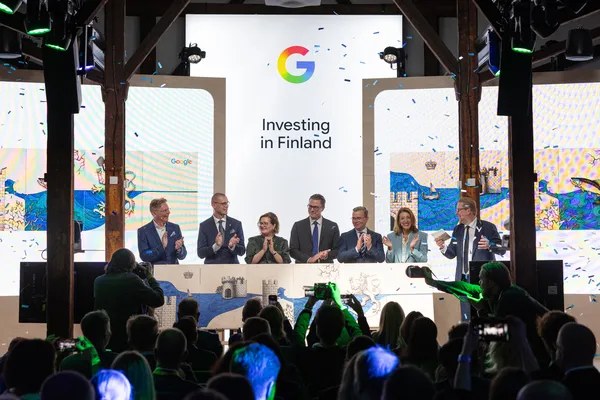
Google announced Tuesday that it will invest at least €13 billion ($15 billion) in digital infrastructure, clean energy, and local partnerships in Finland over the next two years — its largest single investment ever in Europe. Fifteen years after Google converted a former paper mill in Hamina into a data center, Finland has become a vital hub for the company; this new commitment pushes that relationship to a new level.
The investment spans four Finnish municipalities: an expansion of the existing data center in Hamina, plus new projects in Kajaani, Muhos and Vaala. Google expects the 2027-2028 construction program to support more than 37,000 jobs nationwide, alongside clean-energy projects, a community fund, and dedicated programs for biodiversity, education, research, and workforce development. Bikash Koley, Google's vice president of global infrastructure, wrote on the official blog that the spending answers growing demand for core services like Search, Maps and Gemini — services powered by increasingly strained AI compute.
The most striking element is on the energy side: Google signed its first nuclear power purchase agreement outside the United States — a 22-year deal with Finnish energy company Fortum to buy up to half the output of the Loviisa nuclear plant, supporting its operation through 2050. The package also includes a 94-megawatt battery storage system. For AI-era data centers, stable, carbon-free, predictable baseload power is one of the scarcest resources of all — with a single nuclear contract, Google anchored its Finnish compute base to reliable energy.
The investment continues the trend of tech giants clustering data centers in the Nordics: cold weather cuts cooling costs, while stable grids and abundant renewables make the region a natural harbor for AI infrastructure. Google says the program is critical to meeting growing AI and cloud workloads. For a small country like Finland, €13 billion means enormous foreign investment and jobs; for Google, it is a key move in laying the infrastructure for the next generation of the AI race. As the AI race stretches from chips to electricity, whoever secures energy first holds the next ticket.