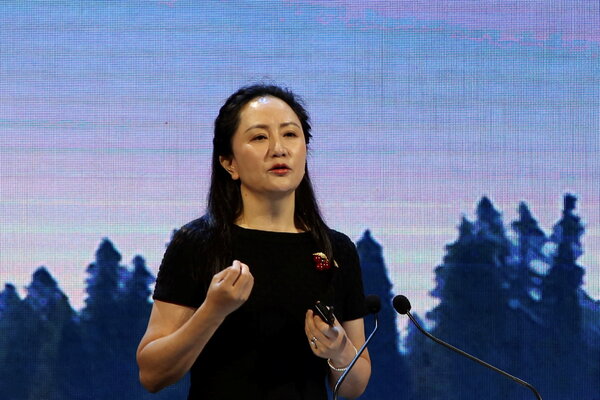
In 2018, an executive of Chinese telecom giant Huawei was arrested in Canada, inflaming already strained relations between Beijing and Washington. After three years of detention in a luxury Vancouver residence, the executive — Meng Wanzhou — reached a deal with federal prosecutors and flew back to China. But that agreement did not end the US government's efforts to prosecute Huawei, which officials say has long disregarded American law, stolen secrets from US companies, and evaded sanctions on Iran.
Now, eight years later, the case against the company is being tried in a federal court in Brooklyn. Opening statements began Wednesday, and the trial could last four months.
"The entire company operates on a pattern of theft, lies, and cover-ups," Tyler Stott, a federal prosecutor with the Justice Department, told jurors. Witnesses expected to testify include former Huawei employees, telecom technology experts, and a banker — to whom Meng admitted concealing Huawei's business dealings in Iran.
Meng was Huawei's chief financial officer and the daughter of the company's founder. She reached a deal with prosecutors in 2021 to avoid prison. Since 2019, Huawei has been effectively barred from selling its products in the US, where officials worry they could pose a national security threat. Huawei continues to sell smartphones and equipment that support phone and internet networks globally. Despite Washington's efforts to slow China's progress, Huawei is also a key part of the Chinese government's plan to develop AI chips. A conviction may not significantly change its fate.
But federal prosecutors are pressing forward with their case against the tech giant, which American officials have long viewed with suspicion. The US has long accused the Chinese government of supporting trade secret theft, spanning everything from cutting-edge defense technology to corn seeds in Iowa. Huawei's defenders argue the case is retaliation for China's use of Huawei technology to build 5G networks worldwide. Huawei denies any wrongdoing, saying it operates independently of the Chinese government and attributes its growth to heavy investment in R&D rather than stealing trade secrets. In two statements, Huawei said "the overall narrative of the US government is demonstrably false" and that it has "the highest respect for intellectual property."
Huawei was founded by Meng's father, Ren Zhengfei, in the 1980s. Its rise has echoed China's own trajectory during the country's major transition toward a capitalist economy. Brian Heberlig, Huawei's defense attorney, said Ren built the company through hard work and "hired people with the same work ethic."
As Huawei rose, US officials worried the company's technology could be used to surveil Americans, that it was stealing from American competitors, and that it disregarded US law to trade with Iran. A 2020 superseding indictment against Meng and Huawei echoed some of those concerns. Prosecutors said Huawei and its affiliates used "a pattern of fraud" to steal trade secrets from American companies, naming six companies whose IP Huawei allegedly stole — identified by The New York Times as Cisco Systems, Motorola Solutions, Fujitsu, QuinStreet and others.
Whatever the verdict, this legal tug-of-war spanning eight years has long transcended one company's fate, becoming a window into how US-China tech competition evolved from trade friction into judicial confrontation.