Breaking News
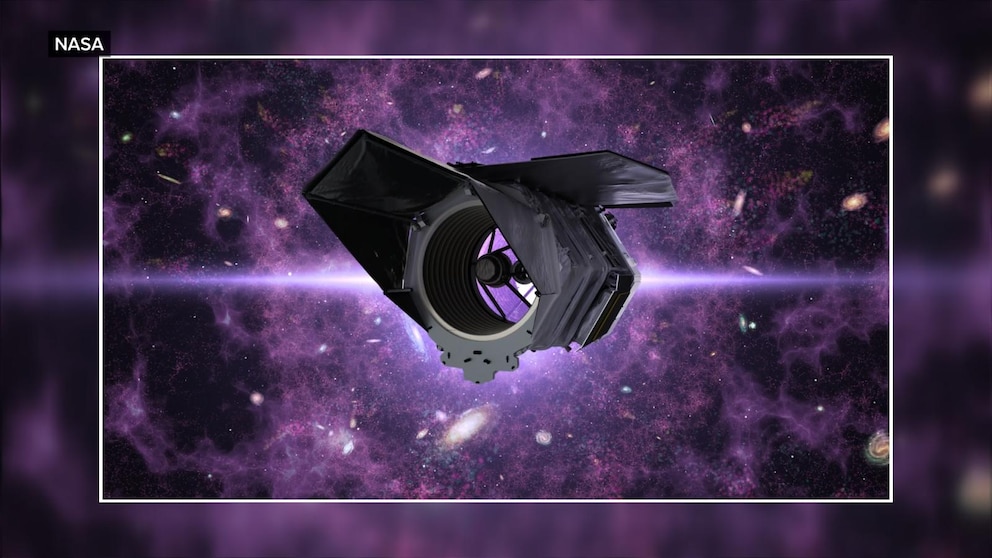
NASA's Nancy Grace Roman Space Telescope is set to launch at 7:26 a.m. ET on August 30 aboard a SpaceX Falcon Heavy rocket from Kennedy Space Center. The 300-megapixel infrared observatory — named after "the Mother of Hubble," Nancy Grace Roman — has a field of view at least 100 times Hubble's, will survey more than 2 billion galaxies, and aims to find roughly 1,000 exoplanets.
It is purpose-built for two of the universe's deepest mysteries: dark matter and dark energy. Dark energy is the mysterious force pushing galaxies apart faster and faster, and the current cosmological model can't yet explain why it behaves differently than in the universe's youth. Roman will use gravitational lensing and supernovas to measure cosmic expansion — potentially confirming or overturning existing dark-energy theory.
After the James Webb Space Telescope, another flagship observatory heads to the Sun-Earth Lagrange Point 2 (about 1.5 million km from Earth). Roman pushes wide-field infrared surveying to new heights, giving astronomers unprecedentedly large samples. Commercial launcher SpaceX cements its role as the go-to carrier for flagship government missions — the privatization of launch is now the default.
You may not care about dark energy, but this telescope is a reminder that humanity is still asking "what is the universe made of?" Its observational data will be public, and within a few years it could rewrite the cosmology chapters in textbooks. The distance to science is shorter than we think.
Our Take
From a girl told "women can't be scientists" to a telescope bearing her name, Roman's own story is more moving than the launch. Science pays back slowly, but one telescope lets us look 13.5 billion years into the past. Some investments aren't measured in the present, but in how far humanity can see.