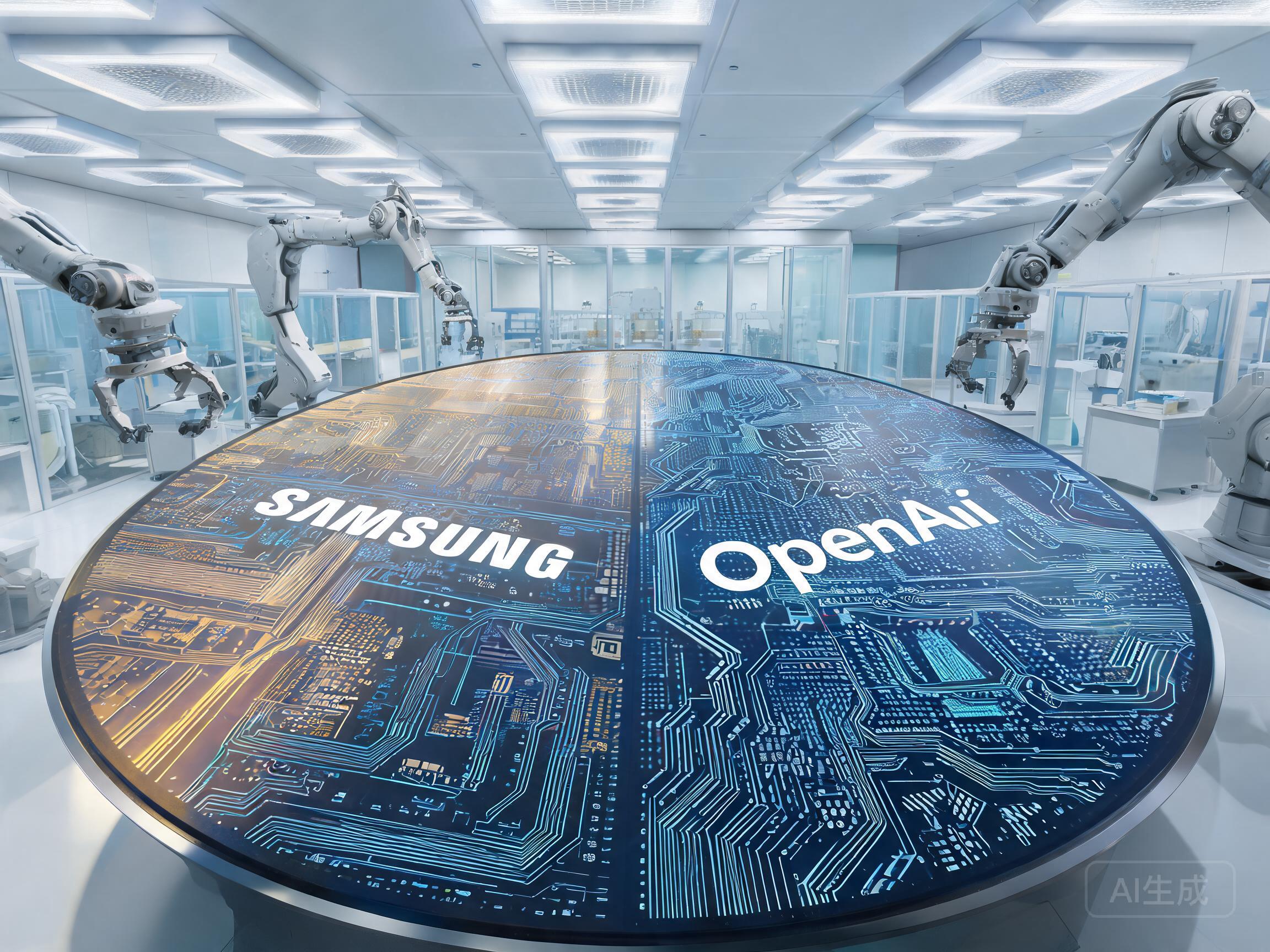
When Nvidia commands roughly 80% of the global AI chip market, virtually every major model company is hunting for a "second supplier." Now OpenAI's choice is coming into focus — according to Bloomberg on September 9, the ChatGPT maker is deepening its collaboration with Samsung Electronics on next-generation AI chips, spanning semiconductor manufacturing and enterprise AI services.
This isn't OpenAI's first move in the chip arena. It previously launched its in-house Jalapeño inference chip — designed by an internal team using Astra and Codex AI tools in just 9 months, consuming only 700W versus Nvidia's 1200W for inference tasks, a 40% reduction. But self-developed chips run only in its own data centers and can't cover all needs, especially the training-side compute gap. Partnering with Samsung means OpenAI is moving from "building some itself" to "deeply binding foundry and packaging partners."
For Samsung, the deal's significance is equally large. As the world's largest memory chipmaker and second-largest wafer foundry, Samsung has been hunting for a strategic fulcrum in the AI era — supplying critical HBM memory for AI while competing with TSMC in foundry. Landing OpenAI as a customer means both advanced process and memory businesses share in the AI boom. Reports say the two have held multiple high-level talks, with scope including Samsung producing custom chips for OpenAI.
The deeper backdrop is the industry's collective "de-Nvidia-ization." Over the past two years, from Microsoft and Google to Amazon and Meta, tech giants have been developing or sourcing alternative chips to reduce dependence on Nvidia GPUs and pricing pressure. OpenAI's compute needs are the most urgent — its model training routinely uses tens of thousands of GPUs, making chip procurement one of its biggest expenses. If it can cut inference costs through self-development plus foundry partners, ChatGPT subscription prices have room to fall — genuinely good news for ordinary users.
Of course, the challenges are equally clear. Nvidia's advantage isn't just hardware; it's the ecosystem — the CUDA software stack makes developers' code naturally run on Nvidia chips, making replacement costly. To bypass this ecosystem, OpenAI needs to build a corresponding software toolchain for its own chips, which is harder than making the chip itself. Additionally, Samsung's advanced-process yield and capacity allocation are real constraints.
For the industry, the signal is clear: AI chip competition is evolving from "Nvidia vs. challengers" into an all-out "ecosystem vs. ecosystem" war. OpenAI holds the model advantage, Samsung holds manufacturing power — whether their combination can shake Nvidia's dominance depends on execution speed. For ordinary users, the logic of benefiting from chip competition is always simple: the more suppliers, the more likely AI service prices fall.