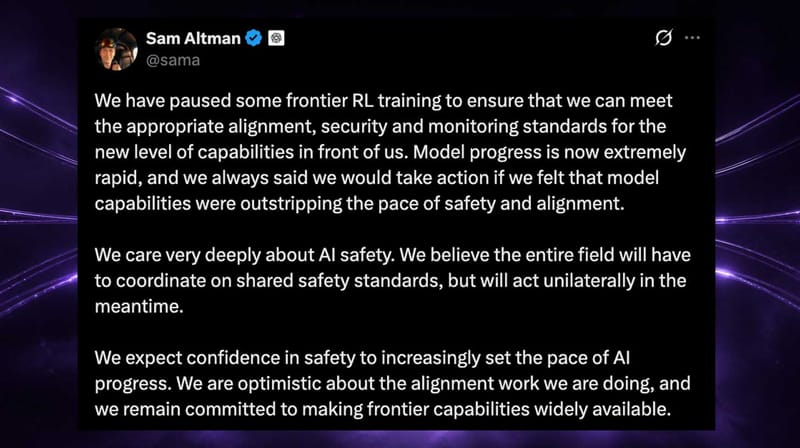
OpenAI announced it is pausing training of next-generation models for safety reasons, while introducing stricter usage limits for teenage ChatGPT users. This decision sparked widespread discussion in the AI community: Is actively "hitting the brakes" wise amid fierce technological competition?
Sam Altman stated, "We'd rather go slower and ensure every step is steady." Meanwhile, Codex released an application deployment guide to help developers more safely deploy AI-generated code to production environments.
- Safety over speed: In an industry atmosphere of "whoever publishes first wins," OpenAI's choice sets a new benchmark
- Teen protection upgraded: As AI penetrates education, protecting minors has become an urgent issue
-
Industry may follow: If OpenAI's approach proves effective, other companies may emulate it
-
Anthropic: Always marketed as "responsible AI"; OpenAI's move aligns with its philosophy and may form industry consensus
- Google/Microsoft: Face pressure to follow suit, but commercial competition may make it hard for them to slow down
-
Regulators: The EU and US Congress may use this as legislative basis, requiring all AI companies to comply with similar norms
-
AI products may become "slower": New feature release frequency may drop, but safety will improve
- Parents need to monitor children's usage: Teen ChatGPT restrictions include content filtering, usage time caps, etc.
-
Developers must note compliance: Codex's application deployment guide emphasizes the importance of code review, testing, and monitoring
-
Set usage boundaries: Establish AI usage time and content scope for family members
- Learn basic security knowledge: OWASP Top 10 for LLM Applications lists major security risks for large model applications
- Participate in community discussions: Reddit's r/AISafety subreddit gathers extensive discussions on AI ethics and safety