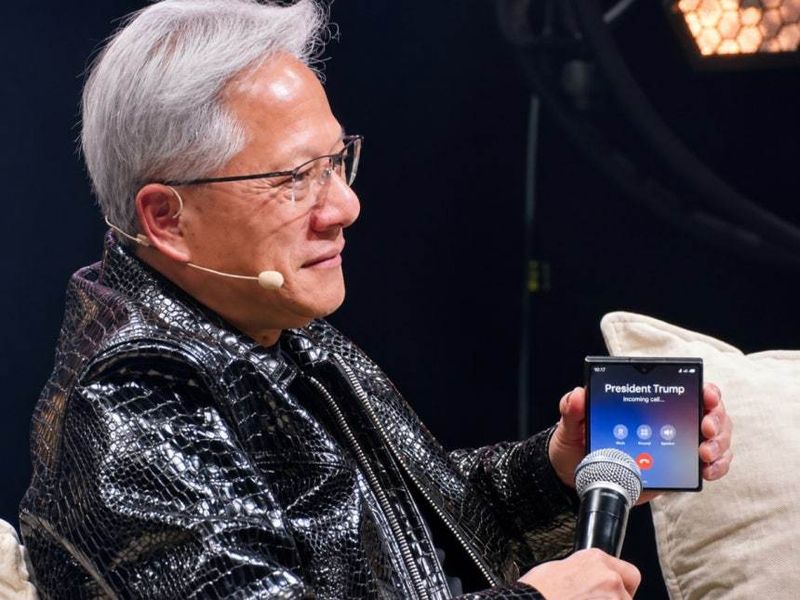
A tech summit interview turned into a live "presidential call-in" broadcast before thousands of attendees, thanks to one phone call from the White House. On September 14, Nvidia CEO Jensen Huang was mid-conversation on stage at the All-In Summit in Los Angeles when an aide handed him a phone — the caller was President Donald Trump.
Huang tried to route the call through the venue's sound system but couldn't immediately find the speakerphone button. Trump quipped from the other end: "The most interesting thing in life is that you can build the world's most complex chips, but you can't figure out how to put me on speakerphone." The crowd erupted in laughter. Once connected, the conversation moved from AI industry pace to grander themes: "The robots will not be taking over," Trump said. "The AI will not be taking over — the whole thing is a hoax!" He then turned to data centers: "They're making the American people and states rich." According to Axios, Trump also stressed that AI development "cannot be slowed," and Huang replied on the spot: "You're right. We're not going to let that happen."
The roughly five-minute call came at the height of the AI slowdown debate: Anthropic CEO Dario Amodei had published an essay urging the industry to pace frontier development, OpenAI's Sam Altman and Elon Musk voiced support, and global chip stocks had suffered a rare selloff. Trump had already dismissed the slowdown calls as a "SICK conspiracy" on social media; now he brought the White House stance directly into a tech summit. And the endorsement of Nvidia — the biggest beneficiary of the AI buildout — further tilted the balance. Huang clearly does not want the industry to hit the brakes.
The call left one memorable footnote: sharp-eyed attendees noticed Huang was holding Apple's unreleased foldable iPhone Duo, a $1,999 dual-screen device not slated to hit stores until late next month — effectively a flex of unreleased hardware during a presidential call. Afterward, at Salesforce's Dreamforce, Huang doubled down: AI safety matters, but the industry needs no new dedicated laws. "The opposition between innovation speed and product safety is a false premise," he said.
When the U.S. president and the world's largest AI chipmaker publicly dismiss risk warnings together, the Silicon Valley fight between "decelerationists" and "accelerationists" has moved from lab debates to the highest level of political theater. Now it's up to Capitol Hill and the markets to respond.