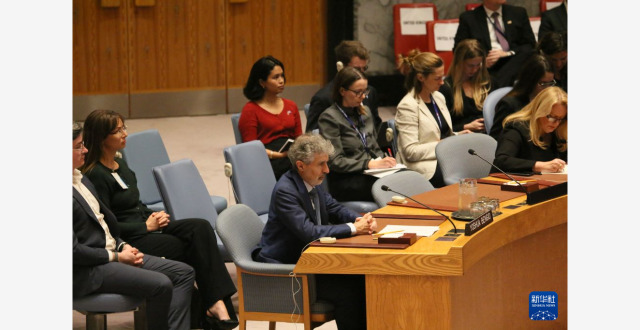
Fierce rivals in the marketplace, the leaders of the world's top AI companies stood on common ground before the UN Security Council. On September 23, the council held a high-level session on "AI and International Security" — and OpenAI CEO Sam Altman, Anthropic CEO Dario Amodei, Hugging Face co-founder Clement Delangue, and Yoshua Bengio, co-chair of the UN's International Independent Panel on AI, addressed the 15 members with one request: please regulate the technology we built.
It was the first time AI company chiefs collectively stood at the council's podium. Altman warned that AI's pace of improvement is nearing the point where "we could lose control of the future to AI," and called for international standards for "measuring capabilities, assessing risks, determining whether safeguards are sufficient and preserving meaningful human oversight." Amodei, appearing by video, was blunter: "If managed poorly, I even believe AI could be a risk to humanity as a whole." He proposed narrow global agreements — such as banning AI's use to make biological weapons, with verification systems and incident-notification mechanisms. Bengio called the moment "a global awakening."
What makes the statements striking is their context. Just a week earlier, these same executives were publicly divided over whether AI should slow down: Trump dismissed the risk warnings as a "hoax," Zuckerberg argued market incentives suffice, and four giants were sued by users as a "slowdown cartel." Now, at the UN, those divisions were shelved in favor of rare consensus: whatever the differences in safety philosophy, AI governance now exceeds the capacity of any single country, company or lab. As Amodei put it, "no single leader, company or country can handle it alone."
The session also exposed deeper governance dilemmas. Convened by France during the annual General Assembly, the meeting reflects global bodies trying to put AI risk on the agenda — yet the real negotiating table may still be between Washington and Beijing, with the Trump-Xi summit days away. As global institutions attempt to institutionalize AI risk while the major powers bargain bilaterally, the question of whether the UN is being sidelined grows louder with every AI advance. The council's session matters, perhaps most of all, as a symbolic starting point: AI security is now a formal item on the international security agenda.