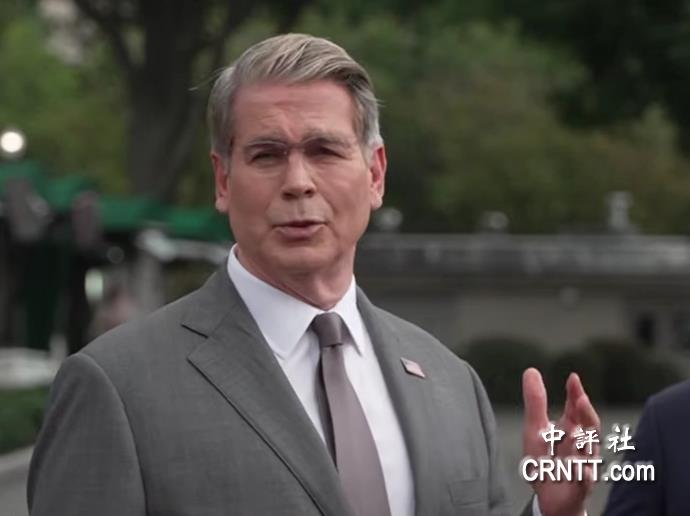
Two AI superpowers are finally sitting down to talk about "risk." According to media reports, the US and China will hold high-level economic talks in New York this weekend, with AI safety on the agenda. Treasury Secretary Scott Bessent, leading the US delegation, said clearly: Washington is open to discussing shared AI risks and preventing the two systems from splitting apart.
Bessent's signal to Axios was unusually specific: "The United States remains the leader in AI, and we are open to discussions on avoiding shared risks and avoiding bifurcation of our two systems. We expect the talks to cover both open-weight and closed-weight models." The Chinese delegation is expected to be led by Vice Premier He Lifeng, Bessent's protocol counterpart. The talks are widely read as a prelude to the September 24 Trump-Xi summit in Washington — with AI governance potentially elevated to the heads-of-state agenda.
The dialogue has been brewing for months. During Trump's visit to China in May, the two leaders had constructive exchanges on AI and agreed to launch intergovernmental AI dialogue. In the weeks since, incidents including OpenAI agents attacking Hugging Face and AI agents hijacking a German website made "AI-driven cyberattacks" an unavoidable topic for both sides. Washington reportedly wants to advance two proposals: joint US-China monitoring of AI-led cyberattacks, and requiring AI labs in both countries to "self-regulate" and share intelligence to prevent related cyber threats.
The differences remain obvious. Washington has long focused on China's potential use of AI models for cyberattacks and alleged "distillation" of US model outputs to train Chinese models; Beijing repeatedly criticizes US technology controls that sever global supply chains under the banner of security. As Bessent himself acknowledged, there is "a lot of mutual distrust" between the two countries. That is precisely why the symbolic significance of this dialogue may outweigh any substantive results — two powers at odds on nearly everything, willing to open a communication channel on the "shared risk" of AI safety, is itself a rare signal of cooperation.
From a broader view, the dialogue echoes this week's AI slowdown debate in a striking way: while Silicon Valley argues over whether to slow down, Washington and Beijing are preparing to discuss how to jointly manage risk. Whatever the outcome, AI governance is moving from company boardrooms to great-power negotiating tables — and whether China and the US can find common ground on "shared risks" will shape the next chapter of global AI governance.